Federal Court Allows TCPA Robocall Suit Over Prerecorded Survey Voicemails
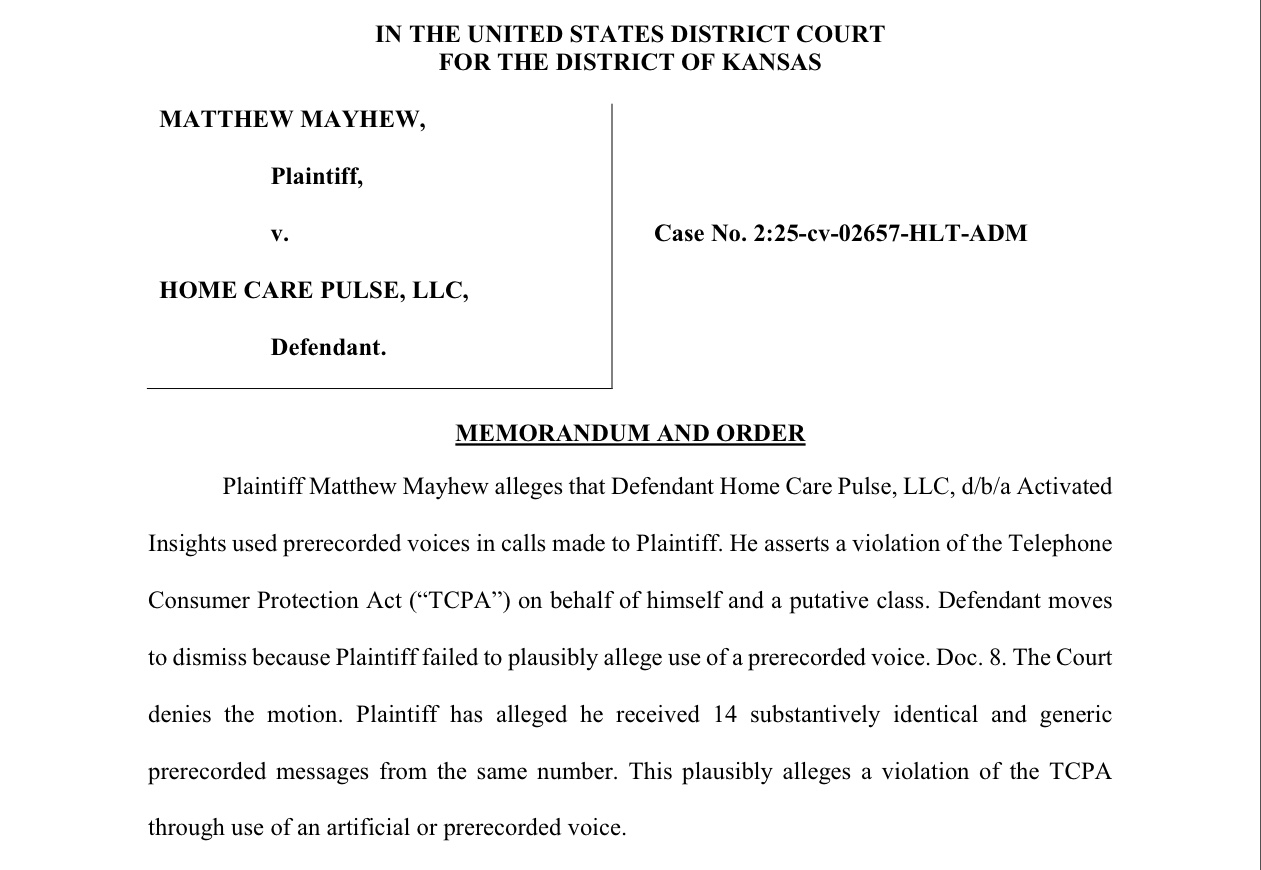
A federal court has refused to dismiss a Telephone Consumer Protection Act (TCPA) class action over repeated prerecorded survey voicemails, ruling that the calls plausibly allege an illegal robocall. In Mayhew v. Home Care Pulse, LLC, No. 2:25-cv-02657-HLT-ADM (D. Kan. June 25, 2026), Judge Holly L. Teeter denied the defendant's motion to dismiss.
The plaintiff alleged he received 14 voicemails from the same number over several months — a generic message stating the company was "calling on behalf of your home care agency" to conduct a satisfaction survey. The messages never used his name, and several were cut off mid-sentence. The TCPA, at 47 U.S.C. § 227(b), makes it unlawful to call a cell phone using an artificial or prerecorded voice without the recipient's consent.
Why this ruling matters
The court held that 14 substantively identical, generic messages from one number plausibly showed a prerecorded voice — and pointed to the truncated messages as further evidence:
That some messages were cut off actually supports an inference that the calls were prerecorded because a live person would presumably not start a message in the middle of a sentence.
The decision is a reminder that "courtesy" and survey calls — not just sales pitches — can violate the TCPA, which allows statutory damages of $500 per call, or up to $1,500 for each willful violation. It also shows consumers don't need technical proof at the pleading stage; details like identical, name-less, repeated voicemails can be enough to move a case forward.
The Wood Law Firm uses the TCPA to stop illegal robocalls and prerecorded calls, and recently noted that consumers can also sue over unwanted marketing texts. If you have received repeated prerecorded or automated calls, you can review your options with no obligation online or by telephone.


